Skip to contentWhere Advanced Technology Powers Real-World Solutions
100+ Research, Academic & Consulting Engagements Driving Innovation Across Engineering, Construction, Product Design & Emerging Technologies.
Confidentiality & Integrity
Research-led & Academic-driven Solutions
Industry Consulting Experience
Certified
Professionals &
Faculty Expertise
Digital Twin Creation for Construction Planning
Industry: Construction / BIM / Automation
Core Focus: Scan-to-3D · BIM Automation · Digital Twins

Read More
Problem Context
Construction teams needed accurate as-built documentation of an existing structure to plan renovations and automation workflows
Traditional survey methods were:
- Time-consuming
- Prone to manual errors
- Poorly integrated with automation tools


Before-state visual
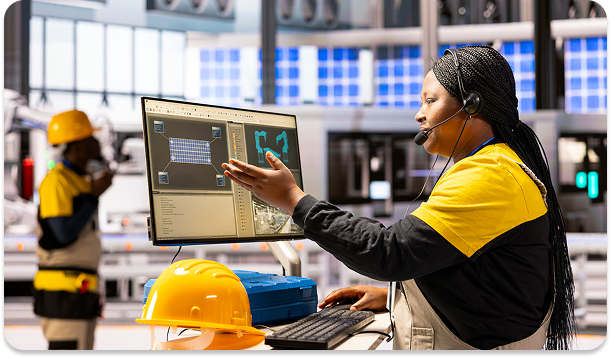
- Photo of an existing construction site
- OR raw LiDAR scan / point-cloud view
(Shows complexity + lack of clarity)
Design & Technology Challenge
The challenge was to convert raw scan data into a usable, intelligent model that could:
- Detect clashes early
- Enable quantity take-offs
- Support automated construction planning
Problem visualization
Messy point-cloud vs clean BIM overlay comparison
Innovxa implemented a Scan-to-3D digital twin workflow, converting LiDAR data into a high-accuracy BIM model, enriched with construction intelligence.
3. Innovxa Solution
Key capabilities:
- Automated clash detection
- Quantity take-offs
- Construction sequencing logic
- Data-validated digital twin
Solution flow diagram
- LiDAR Scan → Point Cloud → BIM Model → Digital Twin


Before-state visual
- LiDAR scanning & point-cloud processing
- Revit / BIM automation
- Digital twin workflows
- Construction data validation systems
Tech stack diagram
Icons representing LiDAR, BIM, Automation, Digital Twin
Problem Context
Construction teams needed accurate as-built documentation of an existing structure to plan renovations and automation workflows
Traditional survey methods were:

- Time-consuming
- Prone to manual errors
- Poorly integrated with automation tools

Before-state visual
- Photo of an existing construction site
- OR raw LiDAR scan / point-cloud view
(Shows complexity + lack of clarity)
Design & Technology Challenge
The challenge was to convert raw scan data into a usable, intelligent model that could:
- Detect clashes early
- Enable quantity take-offs
- Support automated construction planning
Problem visualization
Messy point-cloud vs clean BIM overlay comparison
Innovxa implemented a Scan-to-3D digital twin workflow, converting LiDAR data into a high-accuracy BIM model, enriched with construction intelligence.
3. Innovxa Solution
Key capabilities:
- Automated clash detection
- Quantity take-offs
- Construction sequencing logic
- Data-validated digital twin
Solution flow diagram
- LiDAR Scan → Point Cloud → BIM Model → Digital Twin

Before-state visual
- LiDAR scanning & point-cloud processing
- Revit / BIM automation
- Digital twin workflows
- Construction data validation systems
Tech stack diagram
Icons representing LiDAR, BIM, Automation, Digital Twin
VR Training for Solar Panel Installation
Immersive Safety & Skill Training
Industry: Renewable Energy / Training
Core Focus: VR Training · Safety · Skill Development
Read More
Problem Context
Solar installation teams required standardized training, but:
- On-site training involved safety risks
- Real sites were not always available
- Skill consistency was hard to maintain
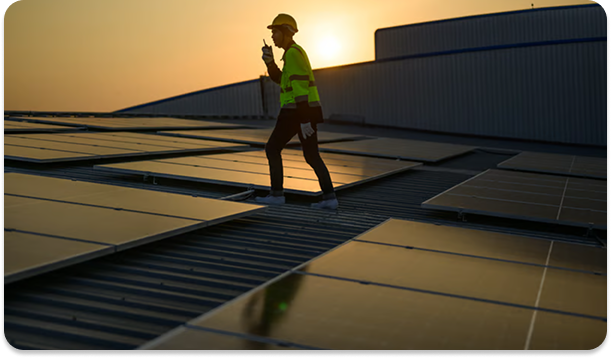
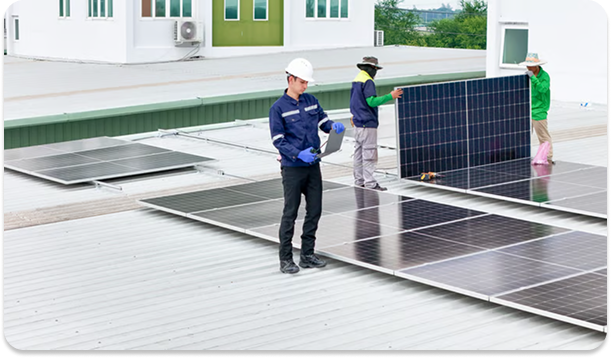
- Real solar panel installation site
- Workers at height (risk implication)


Training Challenge
Key challenges:
- Teaching safety without real danger
- Practicing installation steps repeatedly
Risk visualization
- Safety hazard icons over real rooftop photo
Innovxa Solution
Innovxa built an immersive VR training module simulating rooftop and ground-mounted installations.
The experience included:
- Safety protocol simulations
- Step-by-step installation guidance
- Equipment handling & fault prevention
- Repeatable practice in a risk-free space
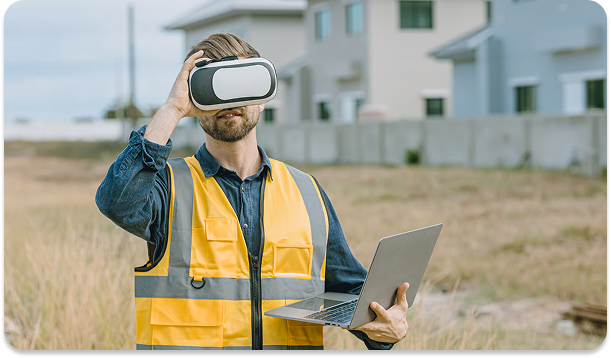
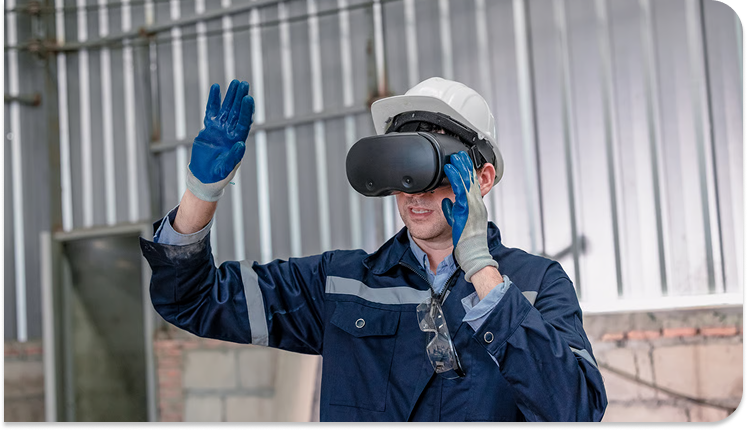
VR environment screenshot
- Trainee wearing VR headset
- Inside solar installation simulation


Tools & Technologies
- Virtual Reality (VR)
- 3D simulation & animation
- Interactive training logic
- Performance tracking systems
System architecture
- User → VR Headset → Training Module → Performance Data
Problem Context
Solar installation teams required standardized training, but:
- On-site training involved safety risks
- Real sites were not always available
- Skill consistency was hard to maintain
- Real solar panel installation site
- Workers at height (risk implication)

Training Challenge
Key challenges:
- Teaching safety without real danger
- Practicing installation steps repeatedly
Risk visualization
- Safety hazard icons over real rooftop photo
Innovxa Solution
Innovxa built an immersive VR training module simulating rooftop and ground-mounted installations.
The experience included:
- Safety protocol simulations
- Step-by-step installation guidance
- Equipment handling & fault prevention
- Repeatable practice in a risk-free space
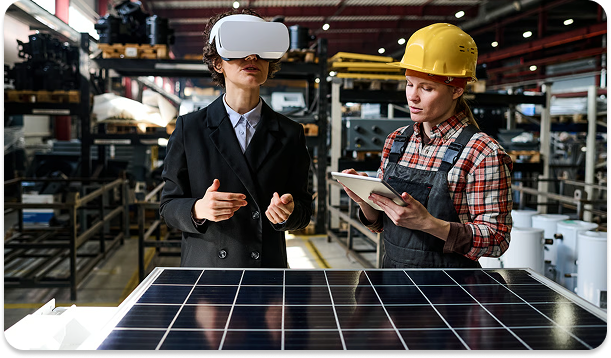
VR environment screenshot
- Trainee wearing VR headset
- Inside solar installation simulation

Tools & Technologies
- Virtual Reality (VR)
- 3D simulation & animation
- Interactive training logic
- Performance tracking systems
System architecture
- User → VR Headset → Training Module → Performance Data
VR & Animation for Land Development & Retail Planning
Pre-Construction Retail Visualization
Industry: Real Estate / Land Development
Core Focus: VR Visualization · Animation · Planning
Read More
Problem Context
Land developers needed to evaluate multiple retail layouts before construction to:
- Maximize land use
- Improve customer flow
- Align business & design decisions
Planning context
- Empty land parcel
- 2D site plan drawings


Planning Challenge
Challenges included:
- Difficulty visualizing spatial impact
- Slow stakeholder approvals
- Late design changes increasing cost
Problem comparison
- Flat 2D plan vs unclear spatial understanding
Innovxa Solution
Innovxa created interactive VR environments and animated walkthroughs allowing stakeholders to:
- Explore retail layouts at human scale
- Compare store sizes & access routes
- Simulate parking, movement & visibility
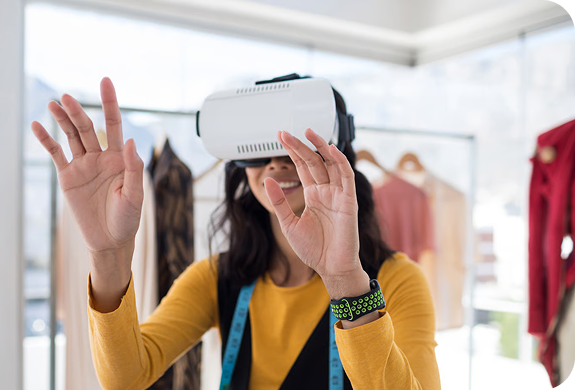
VR walkthrough
- First-person retail space exploration


Tools & Technologies
- Virtual Reality (VR)
- 3D architectural visualization
- Animation & scenario modeling
- Design validation workflows
Visualization pipeline
- Concept → 3D Model → VR Walkthrough → Decision
Problem Context
Land developers needed to evaluate multiple retail layouts before construction to:
- Maximize land use
- Improve customer flow
- Align business & design decisions
Planning context
- Empty land parcel
- 2D site plan drawings

Planning Challenge
Challenges included:
- Difficulty visualizing spatial impact
- Slow stakeholder approvals
- Late design changes increasing cost
Problem comparison
- Flat 2D plan vs unclear spatial understanding
Innovxa Solution
Innovxa created interactive VR environments and animated walkthroughs allowing stakeholders to:
- Explore retail layouts at human scale
- Compare store sizes & access routes
- Simulate parking, movement & visibility
VR walkthrough
- First-person retail space exploration

Tools & Technologies
- Virtual Reality (VR)
- 3D architectural visualization
- Animation & scenario modeling
- Design validation workflows
Visualization pipeline
- Concept → 3D Model → VR Walkthrough → Decision
Portable Medical Ventilator
Designing Life-Saving Ventilation for Anywhere
Industry: Medical Devices / Healthcare Innovation
Core Focus: Product Design · Portable Medical Technology · Human-Centered Design
Read More
Problem Context
Traditional ventilators are:
- Large and heavy
- Difficult to transport
- Dependent on fixed hospital infrastructure
During the COVID-19 pandemic, these limitations became critical—especially for:
- Emergency response situations
- Remote and rural healthcare settings
- Field hospitals and low-resource environments
There was an urgent need for a portable, reliable, and easy-to-use ventilator that could safely support diverse patient conditions.
Context image
- Conventional hospital ventilator (large, complex)
- Emergency or field hospital environment
(Visually highlights the mismatch between need and existing solutions)


Design Challenge
The challenge was to design a ventilator that:
- Is compact and portable, yet medically robust
- Can be operated quickly by medical staff under stress
- Supports patient safety across multiple ventilation scenarios
- Can be developed and validated rapidly during an emergency
Problem framing visual
- Comparison graphic: Hospital ventilator vs portable use-case
- Icons for emergency, rural, transport scenarios
Innovxa Solution
Innovxa designed a next-generation portable ventilator optimized for emergency and distributed healthcare use.
Key design priorities:
- Ease-of-use: One-touch operation with pressure-regulated ventilation modes
- Portability: Compact, rugged form factor with battery backup
- Patient safety: Pressure Support Ventilation, spontaneous modes, and apnea backup
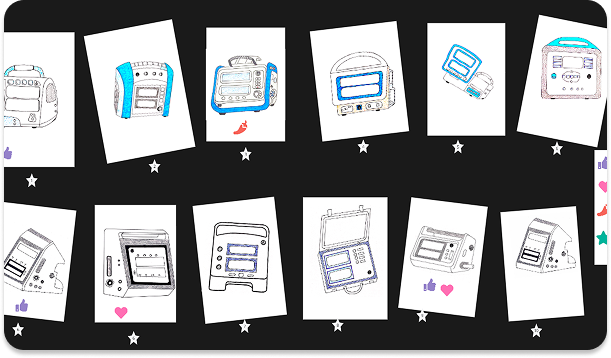
- Rapid development: Concept sketch → functional prototype → market-ready product
- Human-centered design: Interface and controls validated with healthcare professionals
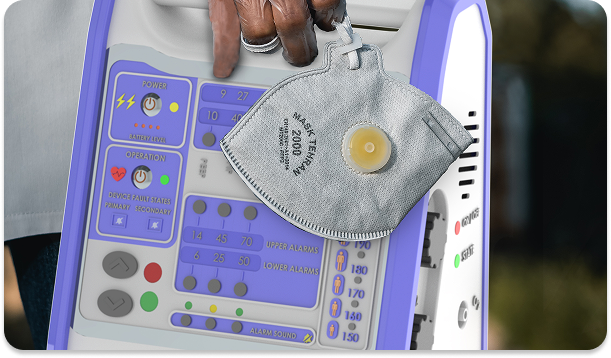
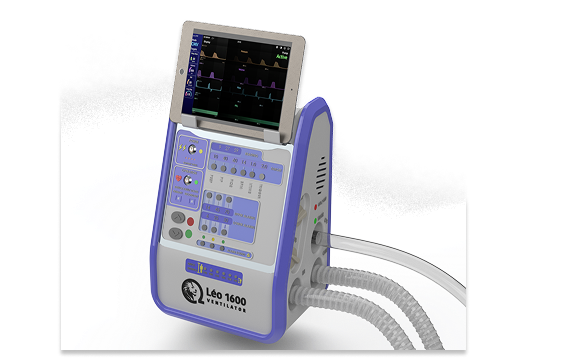
Product hero shot
- Clean render or photograph of the portable ventilator
- Shown in hand, on a stretcher, or in a compact emergency setup


Technology & Design Highlights
- Quick-setting volume-controlled mandatory modes
- Parameters adjustable based on patient height and ideal body weight
- Durable construction for hospitals, field hospitals, and remote care
- Integrated safety monitoring for diverse patient needs
- Optimized internal architecture for mass manufacturing
Problem Context
Traditional ventilators are:
- Large and heavy
- Difficult to transport
- Dependent on fixed hospital infrastructure
During the COVID-19 pandemic, these limitations became critical—especially for:
- Emergency response situations
- Remote and rural healthcare settings
- Field hospitals and low-resource environments
There was an urgent need for a portable, reliable, and easy-to-use ventilator that could safely support diverse patient conditions.
Context image
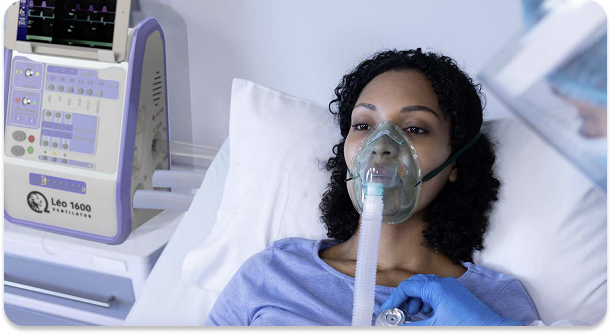
- Conventional hospital ventilator (large, complex)
- Emergency or field hospital environment
(Visually highlights the mismatch between need and existing solutions)

Design Challenge
The challenge was to design a ventilator that:
- Is compact and portable, yet medically robust
- Can be operated quickly by medical staff under stress
- Supports patient safety across multiple ventilation scenarios
- Can be developed and validated rapidly during an emergency
Problem framing visual
- Comparison graphic: Hospital ventilator vs portable use-case
- Icons for emergency, rural, transport scenarios
Innovxa Solution
Innovxa designed a next-generation portable ventilator optimized for emergency and distributed healthcare use.
Key design priorities:
- Ease-of-use: One-touch operation with pressure-regulated ventilation modes
- Portability: Compact, rugged form factor with battery backup
- Patient safety: Pressure Support Ventilation, spontaneous modes, and apnea backup
- Rapid development: Concept sketch → functional prototype → market-ready product
- Human-centered design: Interface and controls validated with healthcare professionals
Product hero shot
- Clean render or photograph of the portable ventilator
- Shown in hand, on a stretcher, or in a compact emergency setup

Technology & Design Highlights
- Quick-setting volume-controlled mandatory modes
- Parameters adjustable based on patient height and ideal body weight
- Durable construction for hospitals, field hospitals, and remote care
- Integrated safety monitoring for diverse patient needs
- Optimized internal architecture for mass manufacturing